
Methods to the Madness: SUNSET BABY & Black Liberation (by Assistant Director Satchel Williams)
Hello, Azuka friends and family —
Lucas here; we’re about to begin our final week of Sunset Baby and are so thrilled at the reception that this show has received. It’s a play steeped in a rich and powerful history, a history of the personal ramifications of political turmoil. At our first rehearsal, Assistant Director Satchel Williams reported on the play’s historical context — and I’m happy to hand the reigns over to her to share that with all of you for a couple of guest posts. Without further ado — Satchel!

Hello hello! My name is Satchel Williams and I had the privilege of serving as Assistant Director on Azuka’s production of Sunset Baby. This is a beautiful, poignant, juicy play about the tumultuous relationship between a father and daughter, and how we perpetuate cycles of pain. Now before you come see our little play for the first of many times (or if you’ve already seen the play and want to dive deeper into the history behind it), I would love to give you a background of the world our characters are coming from.
A few months prior to the start of our play, our central character Nina suffered the loss of her mother, famed activist Ashanti X. She and Nina’s father, Kenyatta were proud revolutionaries back in the 1970s during the height of the Black Liberation Movement. Not to be confused with the Black Liberation Army (we’ll talk about that later, I promise), the phrase Black Liberation Movement refers to the period of time in which several Black activist/advocacy groups came to rise between roughly 1954 to basically present day. It’s what we typically refer to as the civil rights movement.
A blurb on the social conditions that leading up to the birth of the BLM:
“The NAACP filed over 55 desegregation suits in 1955. Emmett Till was lynched in Mississippi while Roy Wilkins was named to succeed Walter White as head of a hounded NAACP throughout the south. Black veterans were, by and large, home, or on their way back from Japan and Korea telling stories of how they had seen those courageous Chinese troops fighting a much better equipped American Army. The ruling class and Joe McCarthy had just finished the job of catching the CPUSA disarmed and flabby – the results of a criminal, revisionist Policy unable to have been turned around. White mobs lined UP to block school doors throughout the south. The battle of Little Rock broke after the people of Montgomery had defeated the Montgomery BUS Company’s Jim Crow Policy.”
Lifted from The Black Liberation Struggle, the Black Workers Congress, and Proletarian Revolution, n.d. [1974]
Rosa Parks’ refusal to give up her seat in 1955 is often cited as the beginning marker of this period. Looking at racial tensions in the past few years alone, it is not hard to see why there is no definitive end to the Black Liberation movement.
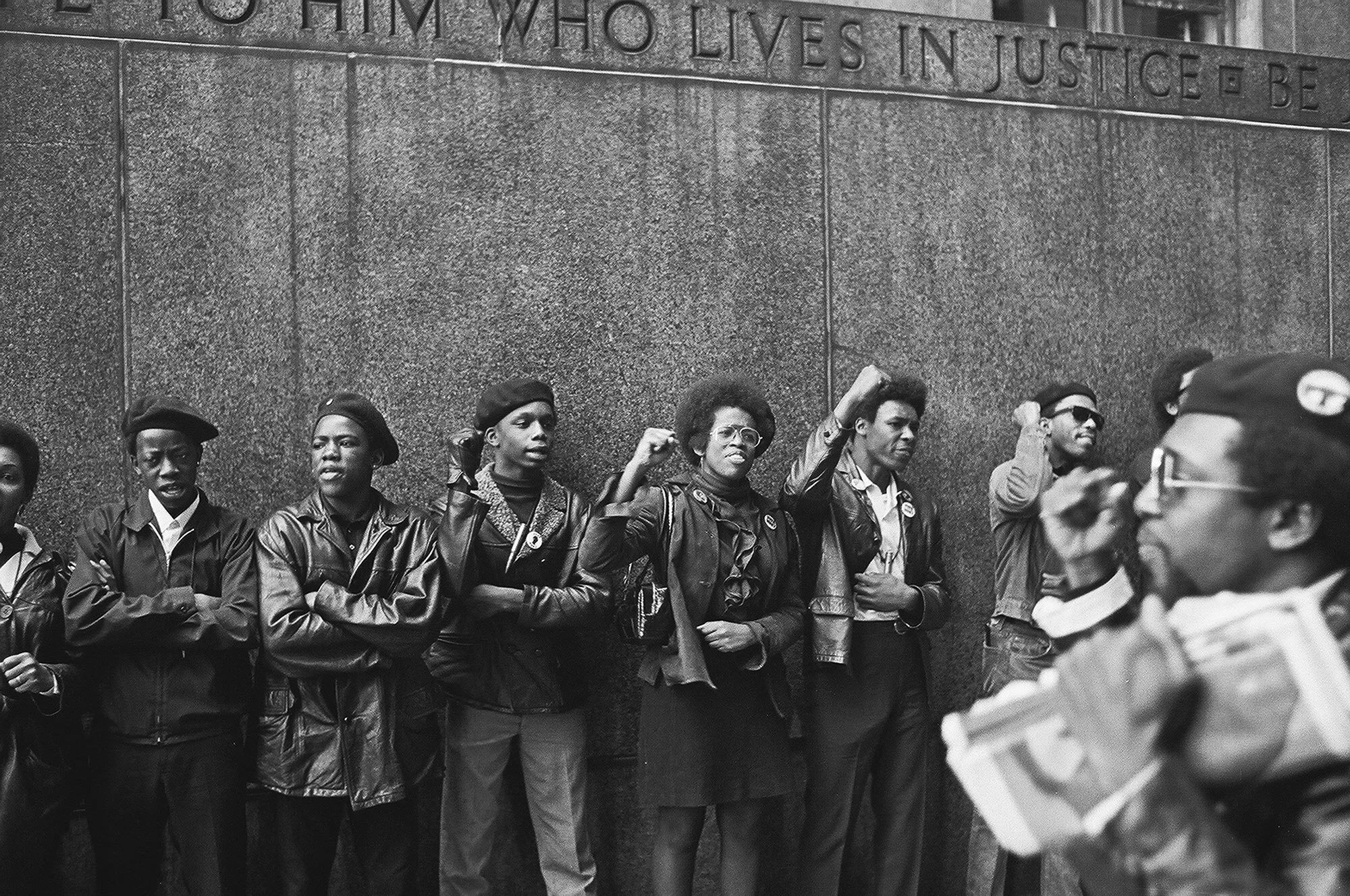
Black Panther Party members outside a New York City courthouse in 1969. // Photo by David Fenton / Getty
The two parties within the Black Liberation Movement that are essential for today’s historical debriefing: the Black Panther Party and the Black Liberation Army.
The Black Panther Party was Active in the U.S. between 1966-82. The original mission statement at its core was to monitor police brutality on Black bodies. The BPP was born out of Oakland, CA after all, and violence from police officers was commonplace. Over time, the party developed community outreach initiatives in many cities, including the Free Meal programs Ashanti X is mentioned spearheading in the play.
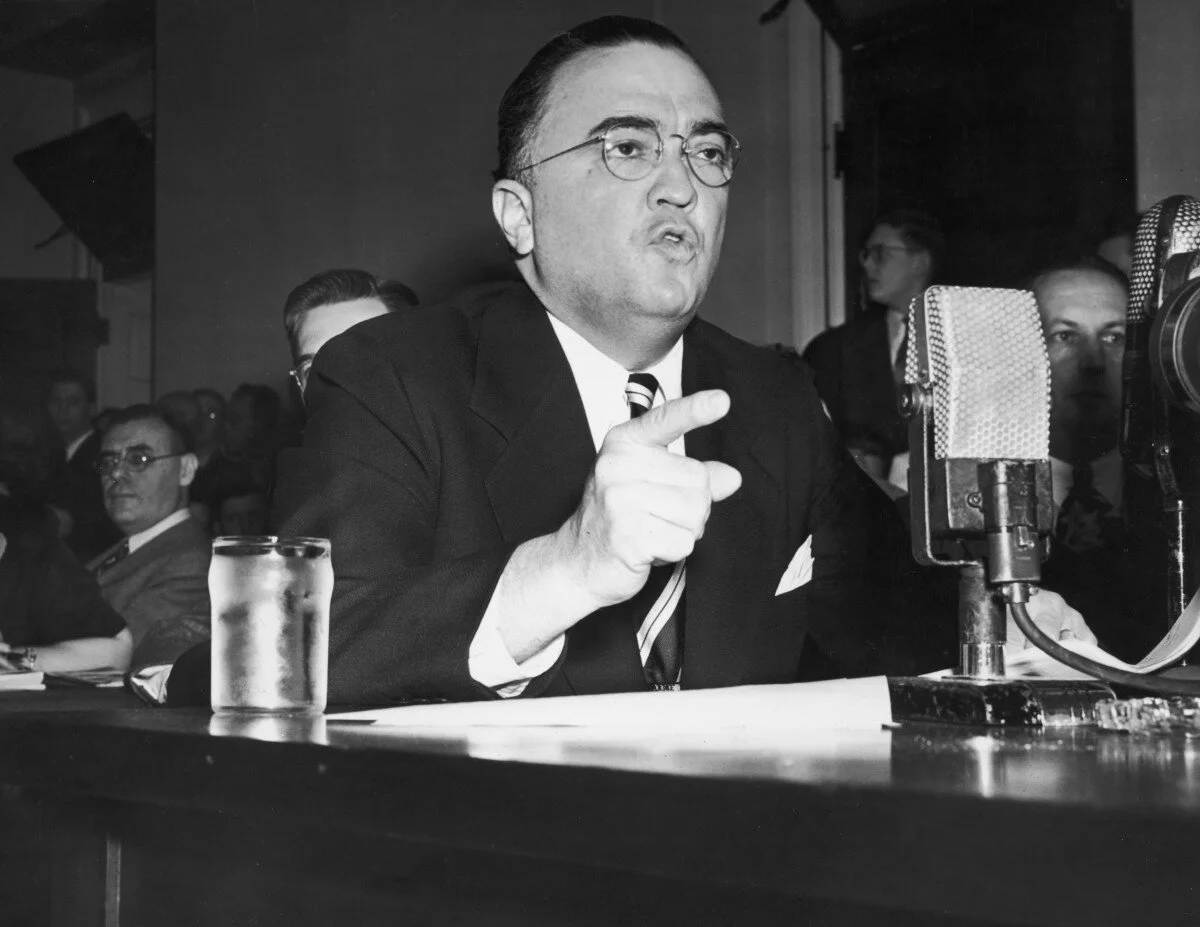
J. Edgar Hoover // Photo: Hulton Archive / Getty
The BPP was villainized throughout the United States. Then-FBI Director J. Edgar Hoover called it “the greatest threat to internal security of the country”. To be honest, it isn’t hard to see why--or better put, it isn’t hard to see why white America saw it that way. The police were essentially a government-sanctioned lynch mob on Black people, but on paper, they were still purveyors of justice. Critiques on the police--no matter their validity--were critiques on America.
The BPP’s influence declined during the 70s; this was largely the result of their vilification by mainstream America. Another key factor in the Party’s decline was infighting. There was a schism developing amongst members. On one hand, community programs are not enough to dismantle the systematic disenfranchisement of Black people. On the other, more overt and assertive forms of protest risk lives. The branch in support of the former argument broke away from the Party to form the Black Liberation Army.
The Black Liberation Army was most active between 1970 and 1981. Their main objective was to declare war on the U.S. government by orchestrating domestic bombings, assassinating police officers, and conducting robberies (the kind Kenyatta more than likely got put away for). The BLA had three core tenets:
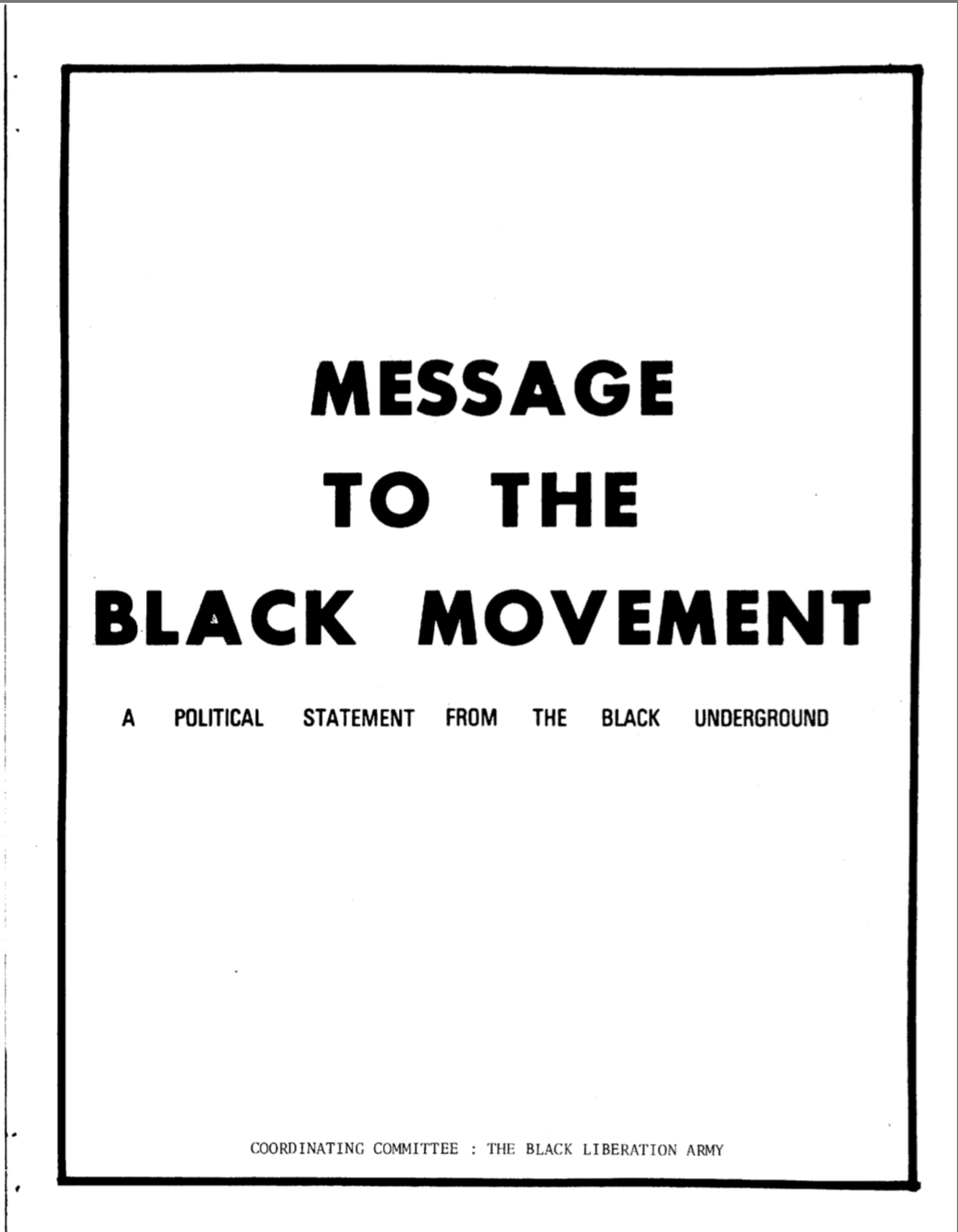
That we are anti-capitalist, anti-imperialist, anti-racist, and anti-sexist.
That we must of necessity strive for the abolishment of these systems and for the institution of Socialistic relationships in which Black people have total and absolute control over their own destiny as a people.
That in order to abolish our systems of oppression, we must utilize the science of class struggle, develop this science as it relates to our unique national condition.
Link to full BLA pamphlet here!
It is easy to characterize the Black Liberation Army as radical extremists. It is easy to write off their actions as senseless violence, as acts of vindictiveness aimed at people not directly responsible for the problems of the world, as examples of why diplomacy and nonviolence are ultimately more effective than hurting potential allies. I ask you, faithful blog reader, not to let go of these opinions if you have them, but to consider how difficult it is to ask a people routinely let down by a government meant to protect its citizens to be patient. Consider how difficult it might be to say to a group of people to wait an indeterminate amount of time for human rights. Consider that if after centuries of being seen as inferior you are still subjugated to disproportionate violence and persecution, it might be hard to see a better future for yourself and your children unless you take direct action.
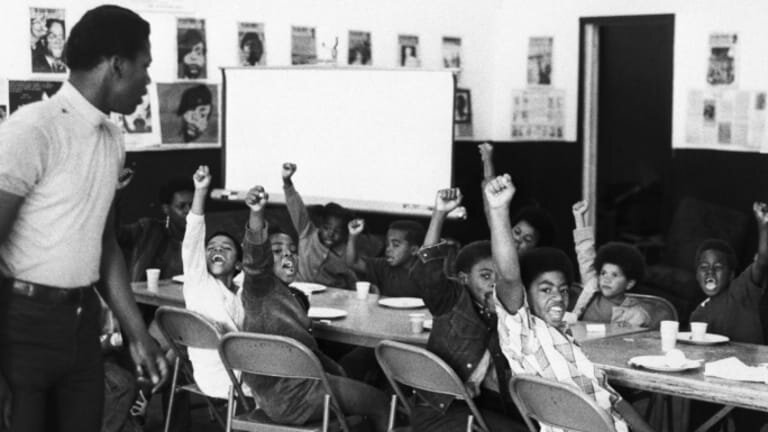
Children receive free breakfast from members of the Black Panther Party // Photo courtesy of History.com
I ask this of you not to coerce you into storming the city or to romanticize anarchy. I ask because these are the questions of morality Black people faced and still face to this day. These are the ideas Sunset Baby wrestles with, and they are fascinating philosophical quandaries. Part of the richness of this play is that it trusts the audience to grapple with what doing right means in a world where most people are born into chaos.
Sunset Baby runs until November 24th! Be on the lookout for my next post on some more background info on this play.